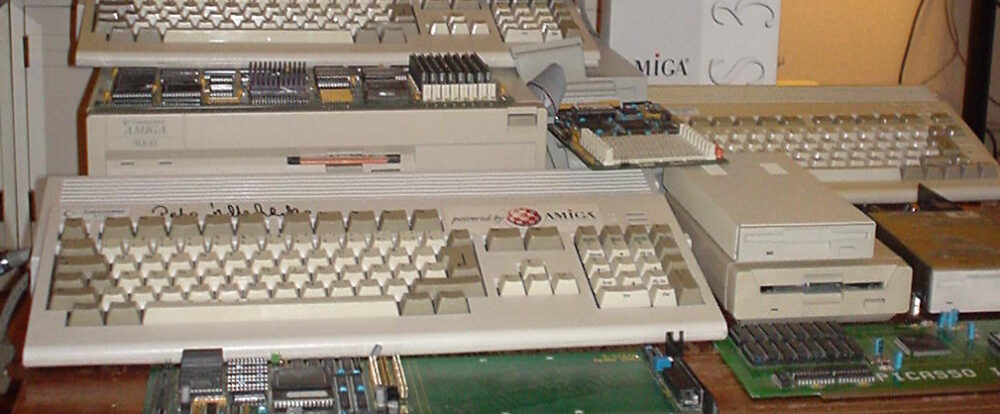
A4000TX with PLCC sockets desoldered and custom chipset removed
The A4000TX in the picture above was one of the first Amiga hardware projects I built. I was clearly way over my head when I took the bold decision to build it with so little prior soldering experience. I got it working in the end – It was a great experience in patience finding the small errors I made before I got it going.
And then I proceeded to build a second A4000TX. The second A4000TX I built was arguable a better build with the custom chipset directly soldered to the PCB, components more neatly soldered and having no 030 CPU soldered to the motherboard. But I had a lot of fun building them both and the learning experience was signficant!
As most beginners chose to do, I built my first A4000TX with SMD PLCC sockets for all PLCC chips. I made the decision to cut off the inner sqare of the PLCC sockets to make them easier to solder. Since then, soldering PLCC sockets with the inner square left is something that pose no challenge for me anymore. So the thought of replacing the flimsy sockets with high quality full 3M sockets has lived rent free in my head for a long time, as has the thought of cleaning up the build a little here and there.
Anyway, I desoldered the PLCC sockets today with a hot air station, then I cleaned up the pads and resoldered some parts that was sloppily soldered. While investigating ways of desoldering the PLCC sockets I got the suggestion to just solder the chips directly to the motherboard. On a second thought, I decided that is the way to go forward as it makes for a more stable setup, better looking hardware and cooler running chips.
Besides, I already have a spare ReA1200 I purchased from another builder with full sockets if I want to test most PLCC chips.
My Amiga Workbench 3.1 installation running DOpus 5.91 Magellan II
I mostly log my Amiga hardware activities on this blog, but I thought it would be interesting taking a look at how I set up Workbench 3.1 for my Amiga 4000D.
I prefer to install Workbench from scratch on my Amiga computers because I think the prebuilt Workbench installations you can find here and there online are configured so different than what I am used to.
While I have moved on to Workbench 3.2 on my main system I still prefer to have an older Workbench 3.1 system running and tweaked the way things looked like back in 1997.
So lets go through my wild WB 3.1 AmigaOS installation “1997 edition” that I recently set up in WinUAE for my A4000D.
Magic Workbench icons
MagicWorkbench 2 was the second Amiga Icon replacement of MWB and much better looking than the first
Back in 1997 you where either running MWB2, NewIcons or the original Commodore Amiga icon set. I prefer MWB2 because it is a beautiful icon set with a lots of icons to download on AmiNet.
Off course this is Amiga, land of drama, conflicts and useless legal battles no matter we talk about peoples egos or the type of icons people prefer – Who remembers the MWB vs NI war from the 90ies (ketchup’n’mustard-look), predating the PowerUP vs WarpOS war a year or two IIRC?
New Icons was fine but I think the design of Magic Workbench icons is just more professional and better, even the third party Magic Workbench icons are generally better looking and faster loading than NI since they are only using 8 colors.
MWB2 drawer icons in my Work: partition
What I like with Magic Workbench is that there is a huge variety of drawers you can chose from. I tend to prefer GlowIcons these days but Magic Workbench is timelessness in icon format, take for example the HDD icon that is iconic Amiga. How would MWB3 have looked liked if it was made? Magic Workbench icons in 64 colors? What could have been – c’est la vie…
Directory Opus 5
A Directory Opus 5.91 Magellan II Lister displaying partition content
I run DOpus5 (Directory Opus 5.91 Magellan II) as a Workbench replacement. DOpus5 is a complex program to talk about. But to explain it in simple terms: I use it to primary get the same functionality you get in Windows when you use Explorer to browse around the file system. But DOpus5 is so much more than just a Windows Explorer clone for Amiga and that is also why it is such a complex program to get into on the Amiga.
Check this out:
This is the content of a drawer containing music modules in a DOpus5 Lister
I have clicked on my Data partition on the image above and dived into the folder structure. I have set it up to open Data: as a DOpus Lister in text mode.
The reason why it is setup like that is the ability to browse in and out of folders quick and easy. See that blue icon in the toolbar with a green arrow pointing up?
One click on that icon takes you up in the file hierarchy. You do not have to open up 100s of drawers (and closing them), you do all the work in one window.
I have a huge module collection with thousands of drawers containing thousands of music modules. Browsing them in DOpus5 is so much more effcient than going through folders, clicking, open and closing drawers in Workbench.
Double clicking a module file opens up HippoPlayer automatically with file types set up
The function that sold DOpus5 for me on Amiga was the ability to browse folders up and down like you do in Windows Explorer (or any file explorer in any OS). But it was also the ability to click on a filetype and automatically open a program that plays or opens the file. Such as clicking on a module file and having it open HippoPlayer and playing the module automatically.
This functionality modernizes Workbench tremendously and makes exploring a huge tree of folders and files much more efficient, like the way you are used to interact with a computer these days.
Outline fonts with Directory Opus 5
Here is another cool function in DOpus5, you can enable outlines on fonts. Makes fonts on Workbench and folders more visible on backgrounds. No need to run a separate hack for this functionality.
DOpus 5 enables button banks if the user so wish to have one.
And here is a little button bank in the bottom left corner, off course you can configure this to be text instead of icons, or configure it to hide itself, or configure it to be an icon, or configure it to be a start menu, or add it as a menu in the WB bar, or change background to be a color or pattern, you get the point.
There are tons of ways of configuring even the smallest things in DOpus 5.
This is both a strength and a weakness. As a reviewer said in his conclusion in an Amiga mag from 1996 “It is very powerful, but I dont have the time to invest learning DOpus5“.
Listers can look like regular Drawers in Directory Opus 5
Just to show an example of how you can confugure DOpus5, I chose to display my Work: partition as a regular partition in icon mode to the left. But I have configured my Data partition to be displayed in a Lister as text only on the right as it contains only data files.
Amateur attempt at pitching DOpusMagellan for Amiga
There are tons of functionality in DOpus5 and I think the problem Directory Opus had BITD was that the authors crammed all possible features and functionality into the program and enabled it as default when you installed it.
I think what they were going for was for the user to go absolute bonkers and excited over all the awesome functionality they managed to add to DOpus. Not expecting users to feel somewhat lost in all menus, options, functionality and occasional bizarre configuration logic.
I spent a week playing around with DOpus5 in the evenings before i got it configured to where I wanted it to be (almost) and when I reached that point it was a very satisfying Workbench experience.
But no doubt, this is a product of its time and it shows in the amount of time that one has to invest to get it going, to understand certain functionality, find solutions to potential problems and figuring out logic behind some configuration options or even get used to non-orthodox ways of handling stuff – such as selecting files and dragging them to another lister.
My suggestion is to disable all functionality that is not needed, the amount of things that can be configured is wild. For example, if you ever has tried a standard installation of DOpus5, you can see that I removed the buttons in the lister that I will never use (such as changing file attributes). That small change makes a huge change in user friendliness.
I also do not need a text button bank with every weird file operation thinkable. In every possible color combination. With secondary function if you click with right mouse button.
Also, it has to be said, that yin-yang symbol for the parent folder button in the Lister toolbar was stupid. Who came up with that idea for that icon must have been responsible for most of the UX in DOpus5, get ready for a crazy ride back to 1997 when bad UX was considered good -because it was not as it was on Windows- if you are brave enough to take the leap.
I mean, if the button is made to go up one level in the file hierarchy, i.e. “parent”, why not just have an arrow pointing up?!
Microknight – System font
Microknight is a great classic Amiga font
Lets talk about the font I am using for CLI and the icons on Workbench. The font is called Microknight. To be honest I do not remember where I found it, but IIRC you can find it somewhere on Aminet in some package, I think it is demo scene related, you just have to Google it.
Microknight is a classic Amiga font with just the right look. Works great in hi-res but also in hi-res laced. I have used it since 1997, will probably use it in 2037!
I use XEN as drawer icons just to get icons sorted more compact with outline enabled. Otherwise there would be huge space between them.
Statram
Statram with the MWB2 icon for RAM:
I found Statram on a BBS in 1998 and really liked it. It is a RAM disk that survives resets. Statram grows with the amount of files that is added to it (SD0:). It is perfect to extract files to. And it is also perfect these days when we can have 256 MB+ without paying through the nose in our top of the line hi end Amiga computers. Some even has 1 GB.
TitleShadow
TitleShadow adds a tiny shadow to the titles on drawer window titles or partition titles.
TitleShadow is a cool Workbench hack that I found this year, wonder why I never found out about it before.
TitleShadow adds a shadow to the title of the drawer windows. Highly recommended. Wish it could be used on the icon text too.
Birdie 2000
Birdie 2000 enables images in Workbench borders for some wild looks.
Birdie 2000 is one of my all time favorite Amiga Workbench hacks/enhancements. It is much more than just a rotozooming image of a cool parrot. It is actually used to place an image file in the border of Workbench drawers (try clicking on the executable).
I remember when it came out, it took the Amiga community -including myself- by storm, suddenly everyone started to experiment with wild setups, from the most extreme to the more subtle – nothing was forbidden and everything had to be proved by taking a snapshot and uploading to AmiNET or shared on IRC.
In my Amiga Workbench setup I have a rather wild setup with many colors, this is supposed to be 1997 after all, but that is no reason not to go for something more subtle such as a light gradient as you can define two colors that creates a gradient from color A to color B.
The possibilities with Birdie for a highly personalized Workbench are endless and I had a ton of fun playing around with it BITD (and today) – I even ran it on my A1200 with AGA and 030 in 128 colors back in 1997!
This was hi end 3D rendered graphics and cool in 1995!
I remember that I emailed the author of Birdie back in late 90ies asking where he found the background image he used on the demo image of Birdie uploaded to AmiNET BITD. He did not have it or knew where he got it. But just recently, 2-3 years ago, I found the exact image as seen above, it is as wild as some Birdie enabled Workbench setups looked like – funny thing is I dont remember where I found it, what comes around goes around…
Birde is configured through CLI but there is a third party GUI for it, although from a usability perspective BirdiePrefs was highly confusing getting used to the first couple of times i used it. BirdiePrefs and Birdie should have been added to Workbench 3.2, make it happen in 3.3!
VisualPrefs
VisualPrefs is an awesome WB hack that lets you change the look of borders and other GUI parts of Amiga Workbench.
If you wonder where the look of the window gadgets comes from on the pictures it is from changing them in VisualPrefs.
I mainly use VisualPrefs to get chunkier buttons for drawer windows and to make the UI proportionally better. There are also some nice options to generally make the UI look better. I set it up to the same style I always run when installing it, XEN gadgets, with thicker title bars and proportional arrows. Exactly as how it looks like in the picture above.
Depending on what screenmode the Amiga is running the gadgets of a drawer can look disproportional. With VisualPrefs it is possible to change proportions of gadgets to make them look better depending on what screenmode you use.
The possibilities in VisualPrefs is huge, but as I said above, I tend to go for the same kind of setup all the time. Which is a shame since there is a ton of functionality and even possibilities of building themes and adding bitmaps to the workbench title bar in it. Maybe some day…
ClickToFront
This is placed in my WBStartup folder to make programs and drawers pop to the front by double clicking the upper border of a window.
KingCon and Amiga shell setup
KingCon is installed to enable tab completion of filenames. I think I will change to CSH as KingCon did not click with me. I have also set up CLI to have a black background with white text.
MUI, P96, AHI and all the rest…
Off course, no Amiga Workbench 3.1 installation is complete without the essential add-ons such as MUI, Picasso96, AHI, data types, a bunch of background images to keep Workbench fresh and that odd app and hack here and there…
I am also running a file requester replacement that I have forgotten how I installed. IIRC it was a replacement library. Main reason the swap file requester was to get directories to list before files in the file requester.
Partition setup
I also want to point out that I always install Workbench to a partition called Workbench (DH0:). I always create a Work partition (DH1:) that contains all programs. If I am installing on to a larger harddrive I also create a Data partition (DH2:) for files such as modules.
Typically I do not install any general use programs to the Workbench partition as that should contain the operating system and files relevant for Workbench only (such as Picasso96, MUI and so on). For example, I do not install Ibrowse to that partition as Ibrowse goes into the Net drawer in Work. Neither Deluxe Paint as that goes into the Graphics drawer in Work.
Some of the ready installations of Workbench floating around the net has a weird missmatch of installed software in different locations all around partitions with less structure than I am used to. It is not bad, just an example of the benefits and freedom of installing Workbench from scratch – You can get it exactly as you want it!
Conclusion
Using an Amiga running a Workbench that is tuned to your preferences is a great pleasure to use.
Apocalypse PrPMC8005E-1259 450 MHz PPC card waiting for its PCI carrier to make it work on a PCI Amiga Z3 system.
Don’t know why or how, but somehow I am back on the classic 68k PPC hype train! Enjoy watching me rip my hair off my head trying to get this PPC board going in my A4000 in the future!